Saturday, April 2, 2022

Hats

sarah's crochet hat

 Hats are a great small project that can be made without a big investment in materials or time.  Everyone can use a hat so it is not a problem if you get on a roll and make too many.  You can wear different hats to suit your mood.  You can give them as gifts or donate them.  Or if you really made too many you can sell them at a craft fair.


Styles, construction methods and materials vary.  The hat in the photo was crocheted.  It is a composite of bits and bobs of wool and wool/mix yarns.  The stitching forms expanding rows of blobs.  The ear flaps and ties are hidden underneath.


tam with beads

The second hat uses the same theme of expanding circles using different yarns.  In some places beads have been incorporated into the kniting.  This one takes the form of a "tam".  It is a good example of using up those tiny bits of yarn that you can't throw out.  Sort them into a colour scheme, pick one and just knit until it runs out then add another at random until the hat is big enough.


Sylvia's stash busting hat

With a little more yarn you can make a classic toque with cables.  If Sylvia's stash busting hat is more your style, you can learn how to knit in the round and produce something similar by taking one of our knitting workshps.  Check out "workshops".


For a practical hat that is stylish, warm and almost water proof you can't beat a wool hat that has been felted.  

Sylvia's felted knit hats
The picture to the left show four knitted hats that have been wet finished to felt them then they were shaped to create different styles.  The elegant red/green hat was created directly from dyed wool that was layered then wet felted and shaped to form a cloche.  


David's wet felted wool hat

Tam and scarf of hand spun wool

If you are a spinner you will appreciate the work involved in the tam with matching scarf.  Look carefully at the photo and you can see the slight variation that suggests the yarn was hand-spun.  The yarn and stitching are quite fine.
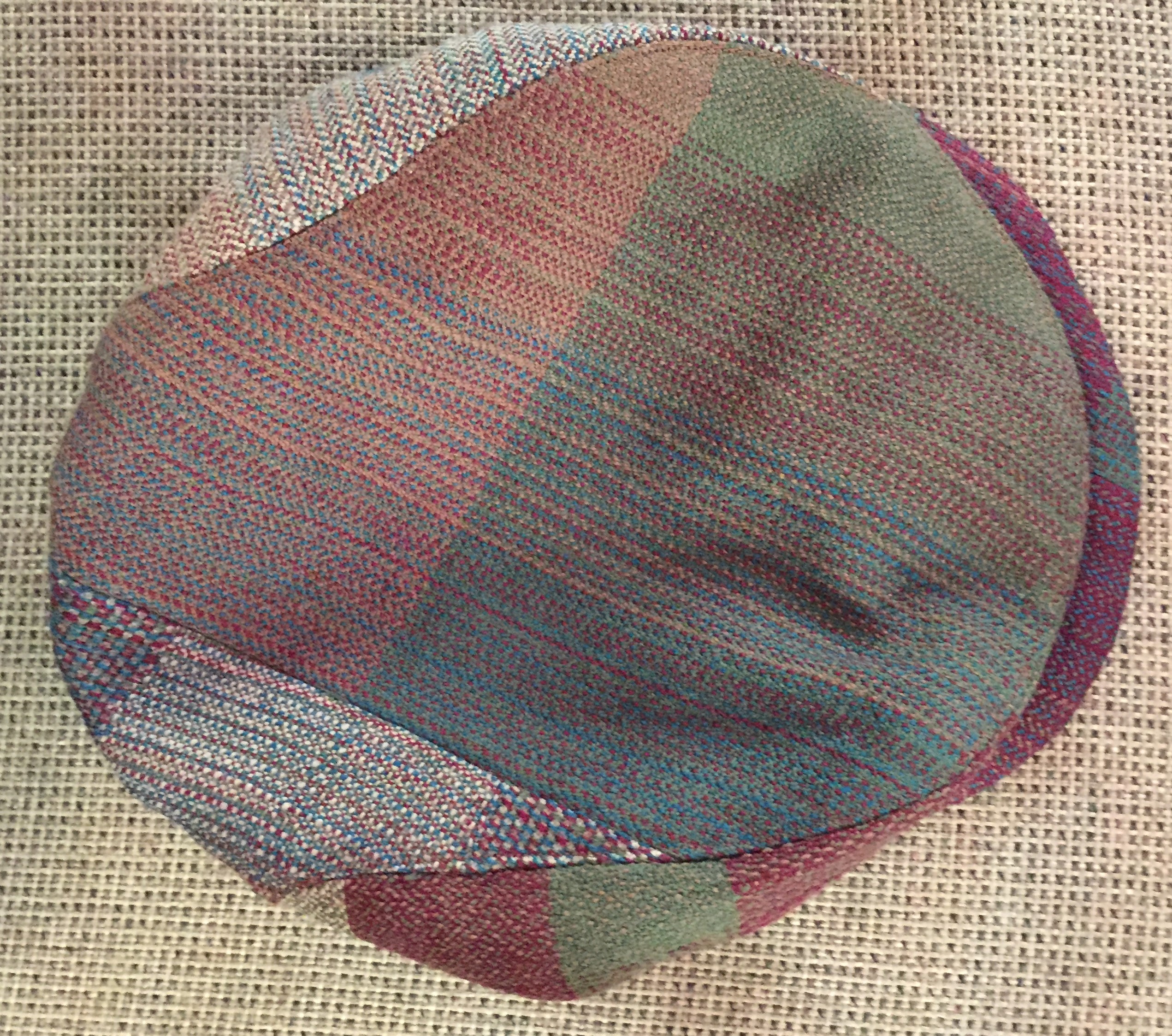


Mary's hat sewn from cloth scraps

You don't have to be a knitter to create a unique hat.  The cap in the photo was sewn from scraps of hand-woven fabric.  The different scraps were woven from fine wool yarns that share colour families so they work together to create an interesting combination.

making a statement hat

And finally we have the "make a statement" hat or the I've got yarn and a crochet hook and an imagination.  It looks warm too.


Tuesday, March 22, 2022

Colour and Weave Effects

variation on hound'stooth
Harness envy is common among those weavers who love pattern. Most patterns depend upon the interlacement of warp and weft to create skips that allow different proportions of either the warp or weft to show on the surface.  To make a pattern you organize those skips into pattern clusters by complex threading and treadling.  The more complex the pattern the more harnesses and treadles you need.

With only 4 harnesses, 6 treadles and 2 feet you may want to take a different approach.   You can use a simpler structure and manipulate the warp and weft colours.  Where the same warp and weft colours cross they will give a solid block of one colour.  This is illustrated in the weaving in the picture with solid white, solid brown and half tones.  When the piece is wet finished the solid areas will form a pinwheel motif.


The workshop "OPTICS" leads students through the principles of using colour and weave structure to create patterns.  It starts with basic principles and culminates in some spectacular colour and weave interactions.  This popular workshop is taught by Linda Wilson, one of our talented members.  The photos below are the works of students who have taken the course.  We thank them for sharing their photos. 

Rita's log cabin sample

One of the simplest forms of colour and weave is the old pattern referred to as "log cabin".  Alternating colours in the warp and weft create horizontal and vertical lines that can be arranged in rectangles of different sizes.  The structure is basic plain weave but the results can be spectacular.

joyce's shadow weave


With a bit of artful threading those horizontal and vertical lines can be turned into graceful curves.  The result is shadow weave.  It has the same structural qualities as the log cabin so it makes a great cloth for just about any project you can imagine.  

Marge's 8 harness shadow weave


On an 8 harness loom you can use shadow weave to make complex patterns without requiring a 3rd foot to work the treadles.  You get the same versatile, solid cloth with no long skips to catch or weaken the structure.

Log cabin derivatives like shadow weave use two contrasting colours in the warp and weft, usually a light and a dark thread.  But spectacular things happen when you start to mix weave structure with multiple colours in the warp.


Val's echo sample


When you pair an advancing threading with rotating colours magic happens.  In the photograph, the blue diamond pattern tends to shift across the warp, becoming smaller until it almost disappears.  The weaving is relatively simple with one shuttle and one weft colour, but look at the colour blending that you get with that single weft colour as it moves across the piece.

With the right colour combination in the warp you can even get iridescence.

The final exercise in this workshop explores the interactions of different weft colours with a single mix of warp colours.  The photo below illustrates that exploration.


Colour variations in tencil

If you think you might like to take this workshop in the future then let us know.  If there is enough interest Linda might be persuaded to do it again.  You can contact our workshop registrar G Best at  courseregistrar.QWSG@gmail.com