Study groups are very popular among weavers. They allow us to learn from the experiences of others. They provide the encouragement and incentive to produce plus there is always someone in the group ready to help when you get stuck.
One of the study groups within the Qualicum Weavers and Spinners started out to explore profile drafts and block designs.
A profile draft is a short hand tool for designing a woven item. It is based on the concept of a block design like the window in this gate.
A profile draft is a short hand tool for designing a woven item. It is based on the concept of a block design like the window in this gate.

Block designs are co mmon when the basic material is a rectangle (bricks or stained glass) or created from a grid made of wood or yarn.
 mmon when the basic material is a rectangle (bricks or stained glass) or created from a grid made of wood or yarn.
As with all new studies, we started out with definitions so that we could speak the language. That meant looking at the design elements of previous projects to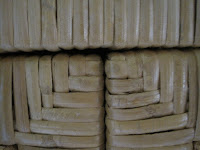 determine what a block design is. We started to see block designs everywhere.
 determine what a block design is. We started to see block designs everywhere.
Our first design attempts involved familiar techniques. It was simple enough at the start but once we understood the concept of a block design and how to create a profile draft a new world opened up.
Soon we were looking at weave structures and learning new definitions such as unit weaves and ti ed weaves. We all discovered at least one weave structure we had never used before. Now when we see a design we have a closet full of techniques that we can apply to that design.
Soon we were looking at weave structures and learning new definitions such as unit weaves and ti
 ed weaves. We all discovered at least one weave structure we had never used before. Now when we see a design we have a closet full of techniques that we can apply to that design.
 We also started to use a holistic approach to design considering the overall design rather than thinking in terms of a motif. Some found scribbling on paper a good start while others found that a scale drawing was im portant for determining proportions.
 portant for determining proportions.
 We learned that more planning is required to match the size of the piece with the size of the blocks and thread counts. Both the width and length need to be considered.
I learned that simple designs could be made to look complex. On the other hand, it takes more effort to create areas with no pattern so that simplicity can be more difficult to achieve. Remember that the next time you see a simple but elegant item.
 I think the most difficult aspect of the study so far is to create a design starting with a blank piece of paper. Something about having no limits can be paralyzing. In this situation, we tend to fall back to the tried and true designs that we are familiar with. That is where the study group provides the support that encourages us to break out of the box and try new things.
 Our group isn't finished exploring block weaves by a long shot. We have just opened the door and while individuals may explore different aspects we continue to come together to share our experience and learn from each other.